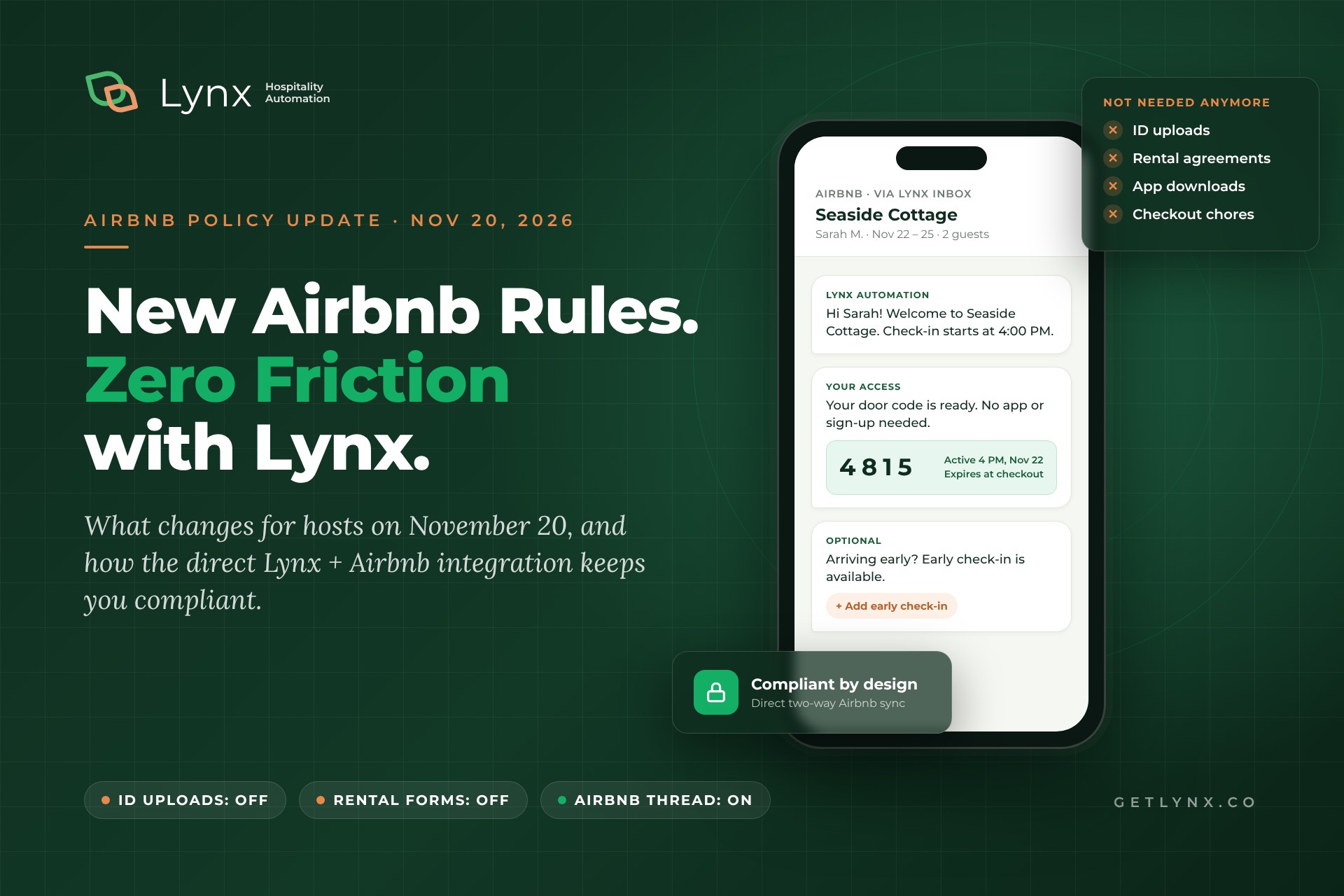
From November 20, 2026, every new Airbnb booking runs on a stricter rulebook: fewer contracts, almost no guest data collection, and no checkout chore lists. If your guest journey still depends on a signed rental agreement, an ID upload or a "register here to get your door code" link, it needs to change before November 20.
Here is the good news. The hosts who will feel this least are the ones whose tools already live inside Airbnb, not around it. That is exactly how the Lynx + Airbnb direct integration was built.
In this post we break down what Airbnb changed, what it means on a real Tuesday night check-in, and how to stay compliant without losing automation or revenue.
The cutoff is the booking date, not the stay date. A guest who booked in October for New Year's Eve stays on the old rules. A guest who books the same dates on November 21 falls under the new ones. Expect to run both rulebooks side by side for months.
The update at a glance
Digital check-in, smart locks, optional upsells and Airbnb-collected fees all survive. What goes is anything that pulls the guest off Airbnb or asks them for data the platform already holds.
1Rental agreements: from "always" to "only four cases"
Under the new Airbnb policy, hosts generally cannot ask guests to sign a separate contract. There are exactly four exceptions:
| When a contract is still allowed | What it looks like in practice |
|---|---|
| Required by law or an HOA / building rule | A condo association that mandates a signed lease addendum for every short stay |
| Access to an optional amenity | A waiver for the e-bike, kayak or golf cart a guest chooses to rent |
| Monthly stays of 28+ nights | A travelling nurse booking 6 weeks near a hospital |
| Airbnb Luxe listings | A staffed villa with concierge service |
Two strings come attached. Any allowed contract must be uploaded to the listing's contract section, where it is publicly visible, so it can't contain personal details. And Airbnb won't force guests to sign it or help you enforce it.
What this means: a 3-night beach-house stay with no HOA rule can no longer be gated behind a signature. Your protection now comes from clear house rules, Airbnb's own guest verification and smart, well-monitored property tech, like Lynx Smart Device Management.
2Guest data and ID: off-limits by default
This is the change that will catch most operators out. For new bookings, hosts may not ask for any of the following at any point in the booking or stay, unless an exception applies:
- Phone numbers, email or home addresses
- Passport, driver's licence or ID photos
- Card or bank details outside Airbnb's payment rules
- Background or credit checks
- Biometric or health data, including facial recognition selfies
The exceptions are narrow: a law (such as a city's guest-registration rule) or a documented HOA or building rule, plus whatever is needed to sign an allowed contract. Even then, you must say what you collect and why in the listing's requests section, collect no more than required, and store and delete it securely.
You can still look at a guest's ID in person at check-in if your listing says so. You just can't keep a copy.
Why Airbnb feels confident doing this: it has required identity verification for 100% of guests booking homes since June 2023. Every person who books your listing has already been checked by the platform. A second ID upload in your own portal is now treated as friction, not safety.
3Apps, WiFi portals and checkout chores
Apps and portals. You can't make a third-party app or website the only way into the property or a critical amenity. Keyless entry apps that need registration are fine, as long as you offer another way in when a guest asks. WiFi splash pages that ask for an email are out unless you're a hotel or resort.
House rules. Airbnb now uses seven standard house rules: overnight guest limits, quiet hours, events, pets, smoking, commercial photography and locking up at checkout. Everything else is a "request", and all of it must be on the listing before booking. No new rules by text, sign or in person after the guest has booked.
Chores. For bookings from November 20, hosts generally can't ask guests to wash dishes, strip beds, start laundry or take trash off-site. Guests have complained about this for years; one 2022 TikTok of a host's chore list drew nearly 5,000 comments.
Enforcement. Violations can lead to warnings, a notice on your listing, reduced visibility, or suspension for repeat offences.
Why a direct Airbnb integration matters now
Most guest-experience tools work around Airbnb: they pull a calendar feed, then try to move the guest into their own portal, inbox or app to collect phone numbers, IDs and signatures. That model is exactly what the new policy targets.
Lynx works inside Airbnb. Its direct, two-way Airbnb integration connects to your Airbnb account itself, not an iCal feed. Here is what that gives you under the new rules:
Messages stay on Airbnb, automatically
Airbnb guest threads land in the Lynx Unified Inbox next to SMS and email. Automated messages to Airbnb guests go out through the Airbnb message channel, so you never need to ask for a phone number or email.
Access without forced registration
Lynx generates door codes for each synced stay and delivers them in the Airbnb thread. No account to create, no app to download, no form to fill. That is the "alternate access method" Airbnb asks for, built into Lynx Contactless Check-In/Out by default.
Stay requests handled in one place
Inquiries show dates, guest count, expected payout and Airbnb's response deadline. Accept or decline without leaving Lynx, so you never miss a response window.
Airbnb-only automations
Triggers can fire only when the booking source is Airbnb. Keep your direct-booking or Vrbo flows as they are, and run a policy-safe flow just for Airbnb guests with Lynx Workflow Automation.
Three setup modes
Inbox only for teams already on a PMS like Streamline or Track. Access Management and Inbox for hosts and HOA owners with no PMS: Lynx imports listings, stays, check-in times and Wi-Fi details automatically. Access Code only for operators who just need codes on the lock.
Upsells stay optional and compliant
Early check-in, late checkout and gap-night offers remain allowed when guests choose them. Lynx also notes that gap-day automation can lift revenue by up to 11%.
Security without paperwork
Noise sensors, occupancy monitoring and smart locks across 300+ supported devices protect the property in real time, and credentials expire at checkout. That fills the gap a signed agreement used to cover, without asking the guest for anything.
Picture this: Say a 12-unit operator sends every guest a portal link for ID upload, a rental agreement and a phone number before releasing the door code. After November 20, that flow breaks the rules for most stays. With Lynx connected directly to Airbnb, they send a welcome message, the code and house guide inside the Airbnb thread, while noise and occupancy sensors handle risk in the background.
The guest journey, before and after
✕ Portal-first flow: breaks the new rules for most stays
✓ Lynx + Airbnb direct integration: compliant by design
Same booking, same property, same smart lock. The difference is where the conversation happens and how much the guest is asked to hand over.
Your pre–November 20 checklist
Quick FAQ
Do existing reservations change?
No. Anything booked before November 20, 2026 keeps the rules that applied when it was booked.
Can I still use smart locks and keyless entry?
Yes. Just offer a way in that doesn't require registering for another app if the guest asks. With Lynx, the code arrives in the Airbnb thread by default. See how keyless check-in powers the entire guest journey.
Can I still check ID?
In person at check-in, if your listing says so, without keeping a copy. Digital collection needs a law or documented HOA rule behind it.
Do I lose upsell revenue?
No. Optional extras like early check-in or late checkout are still allowed, as long as access never depends on buying them.
Make the change in one afternoon
Airbnb is pushing the whole industry toward a simpler, more private arrival. Lynx was built for that: one inbox, codes delivered on Airbnb, automations that respect the channel, and property tech that protects you without paperwork.
Already on Lynx? Open Integrations in your dashboard, connect your Airbnb account and choose your mode. New to Lynx? Book a demo or write to sales@getlynx.co and we'll review your Airbnb setup before November 20.
Book a demo See all integrationsKeep reading
This post summarises Airbnb's published policy as of November 5, 2026 and is not legal advice. Check local rules for your market.